Apologies that I've been a little slack on the blogfront lately...busy...lazy...you know....
Anyhoo, here's the first overdue posting about my PSJ internships. Internship #1 is for an organisation called the The Heschel Center. Their focus is sustainability education and leadership - they do so many interesting things, from operating a "Green Schools Network" to supporting local governments to develop policies and projects geared towards bringing Israel towards a more sustainable future. My main projects there relate to redevelopment of the English-language website, and newsletters for English-speaking supporters and donors to update them on all the fabulous work being undertaken by the Heschel Center. For the first month, I have a fellow intern working with me (Emilie from Northern California), and for the second month I'll be flying solo. In between the website and newsletters, all kinds of other jobs pop up, including editing reports, producing a promotional postcard/folder, etc. I like the people in the office, and the kitchen setup is very great for making coffee and chatting. The office is only about 15 mins walk from my apartment - as a matter of fact it's probably about the same distance as it was from my Mt Vic flat to NZCER! I walk down this street called Nachalat Binyamin, which seems to comprise about 10 solid blocks of fabric stores. Seriously, almost every store seems to be a fabric store. For 10 blocks. One of these mornings I'm going to take some photos to show you.
Wednesday, July 25, 2007

Monday, July 16, 2007
Our Slum
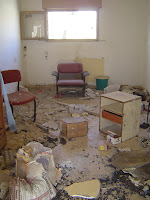
...And here is the slum next door, where we sometimes go to pick up someone's weak but unsecured wifi signal.......




Sunday, July 15, 2007
Our Apartment
Here's a few photos of the inside of our apartment; my room is the one with the purple towel hanging over the back of the chair. 


Wednesday, July 11, 2007
Elegant Slumming
Tomorrow it’ll be a week since I moved to Tel Aviv to start phase two of my WUJS programme – the PSJ (Peace and Social Justice) internship. Although it’s only been a week there’s lots to say about this new chapter in my Israel adventures, so I’ll try to work through them in a systematic kind of way….one blogpost at a time….
THE APARTMENT
I’m living with 3 other WUJys in an apartment on King George St, which, if you don’t know Tel Aviv, is very central to all the good stuff – the markets where you can buy fresh produce, jeans, bread, tchachkas, and whatever else your heart desires; cool cafes and shops.The beach isn’t so far…. (OK, so it’s kind of a shlep on foot but not for a hardened Welly walker!). The apartment itself is pretty small for four people, but fortunately two of our roomies have kind of taken to living elsewhere so it’s mostly just me and Laura, a cool Canadian social worker. The apartment interior is brand new; the fridge, toilet, and pretty much everything else still had the “brand new” labels and stickers on them when we moved in. The apartment backs onto a little park, with some fun kiddie playground equipment and a dog exercise area. We are on the 4th floor, with no elevator, which means shlepping up the stairs every day…which is probably a good thing as that’s about the most exercise I’m getting these days….apart from swinging on the playground swings of course!
In the apartment, there’s a door in the living room that opens onto an open roof/balcony thing. This might have had great potential for evening lounging, except for the fact that it is a complete garbage heap. Really. See, the building adjoining ours is a completely abandoned slumville. Meaning: it’s a dirty dirty mess filled with abandoned dirty and broken furniture. There is more dirty broken abandoned furniture on the roof/balcony that connects our building to theirs, not to mention large piles of bashed up gib board. I assume this came from our apartment when they were ripping out all the old dirty crap before transforming it into the modern chic interior we have today. Fortunately, Laura and I are doing our best to redecorate the apartment so that it’s more in keeping with our environs. We call our style “ghetto”. This look is achieved by finding various not-too-dirty additional elements of furnishing and dragging them into our apartment to make it more homely and/or practical. Thus far we have brought in a couple of mattresses, and a filthy broken wardrobe which we cleaned up and used to string up a “privacy curtain” for Laura, whose bed is in the living room. There are some dress mirrors in the slum that would be nice, if we could figure out how to unscrew them from the wall…..
Anyway all in all there isn’t much to complain about, apart from the LACK OF INTERNET (this shall be the subject of another blogposting), and the location could hardly be better. Oh – importantly the shower has great water pressure. I thought I should mention that, especially in case Greg is reading this….
THE APARTMENT
I’m living with 3 other WUJys in an apartment on King George St, which, if you don’t know Tel Aviv, is very central to all the good stuff – the markets where you can buy fresh produce, jeans, bread, tchachkas, and whatever else your heart desires; cool cafes and shops.The beach isn’t so far…. (OK, so it’s kind of a shlep on foot but not for a hardened Welly walker!). The apartment itself is pretty small for four people, but fortunately two of our roomies have kind of taken to living elsewhere so it’s mostly just me and Laura, a cool Canadian social worker. The apartment interior is brand new; the fridge, toilet, and pretty much everything else still had the “brand new” labels and stickers on them when we moved in. The apartment backs onto a little park, with some fun kiddie playground equipment and a dog exercise area. We are on the 4th floor, with no elevator, which means shlepping up the stairs every day…which is probably a good thing as that’s about the most exercise I’m getting these days….apart from swinging on the playground swings of course!
In the apartment, there’s a door in the living room that opens onto an open roof/balcony thing. This might have had great potential for evening lounging, except for the fact that it is a complete garbage heap. Really. See, the building adjoining ours is a completely abandoned slumville. Meaning: it’s a dirty dirty mess filled with abandoned dirty and broken furniture. There is more dirty broken abandoned furniture on the roof/balcony that connects our building to theirs, not to mention large piles of bashed up gib board. I assume this came from our apartment when they were ripping out all the old dirty crap before transforming it into the modern chic interior we have today. Fortunately, Laura and I are doing our best to redecorate the apartment so that it’s more in keeping with our environs. We call our style “ghetto”. This look is achieved by finding various not-too-dirty additional elements of furnishing and dragging them into our apartment to make it more homely and/or practical. Thus far we have brought in a couple of mattresses, and a filthy broken wardrobe which we cleaned up and used to string up a “privacy curtain” for Laura, whose bed is in the living room. There are some dress mirrors in the slum that would be nice, if we could figure out how to unscrew them from the wall…..
Anyway all in all there isn’t much to complain about, apart from the LACK OF INTERNET (this shall be the subject of another blogposting), and the location could hardly be better. Oh – importantly the shower has great water pressure. I thought I should mention that, especially in case Greg is reading this….
Tuesday, June 26, 2007
Family time...

Mum and dad have been visiting for the last week and a bit, keeping me entertained while I'm on my mid-semester vacation. Although they're not here for that long, we've managed to do a lot of different things, including:
* Lazing around by the pool at a Hotel by the Dead Sea with my "adopted" Arad family (pictured)- very needed after a long trip from New Zealand via Bangkok....
* Two days in the area near Haifa, where we visited an artist's village called Ein Hod, also The Atlit Detention Camp, where Jewish refugees were put by the British during the British Mandate period (prior to 1948), swam at Habonim beach, met friends in Haifa for dinner, and had a quick peer at the famous Bahai Gardens

* An afternoon in Safed, an ancient mountaintop town which gave birth to much of the mystical Kabbalistic tradition
* Driving up the Hula valley - highlight, the Naot outlet factory shop, where I bought some very nice pink sandals...
* Sunset and Dinner on the beautiful Golan Heights with our friends Razia and Ekel

* Walking around the excavated remains of the ancient city of Bet She'an, followed by a wander through the somewhat-touristy-yet-actually-impressive scale models of Mini Israel (Their slogan is brilliant :"See it all....see it SMALL!")

* Wandering around the Old City of Jerusalem on foot, and touring around the whole city on a sightseeing bus
* Catching up with friends JoEllen and Shoshanna in Jerusalem, eating well, and torturing my poor dad with the endless quest for the perfect pair of earrings (which requires us to look in every shop, of course....)
* Drinking endless cups of delicious Mint Tea

Mum and dad only have a couple more days here, and tomorrow we're off to Tel Aviv. It's been very fun having them here to visit, and I acknowledged the importance of their long long journey by snubbing the Israeli Prime Minister in order to hang with them instead! (True story). In two days' time, boo hoo, they have to return to New Zealand, and I will be moving into an apartment on King George St. Here's hoping (for my sake and yours) that I'll have a good internizzle situation in my new home....
Thursday, June 21, 2007
Last week in Arad... :'(
I can hardly believe it, but I only have 5 more days until the end of the first half of WUJS. This means only 5 more days of full-time living in Arad! I have quite mixed feelings about it; on one hand, I am VERY excited about moving to Tel Aviv to start my PSJ Internship (this will be the subject of future postings), and to live a little more in the "real world" of Israel. On the other hand, I have grown very attached to my little desert hometown, and the WUJS routine, and there are many things I am going to miss....
Anyway, this week has been yet another busy one. I had two fieldtrip days that I really want to write about:
TUESDAY
This week, a theme of our learning has been "The Holocaust in Israeli Consciousness". Like many people, until now I have always associated Holocaust memorialisation in Israel with Yad Vashem, which I visited in 2001 on Birthright. While I think Yad Vashem is an excellent and important place for all visitors to Israel to see, one can't deny that it is a deeply harrowing experience to spend a day there. This week, with WUJS, we travelled not to Yad Vashem but to a place Massuah up near Netanya. I'd not heard of this place before. As their website explains,
We had a few discussion workshops with the Massuah educators, and we also visited a couple of exhibitions at their museum, all of which were thought-provoking. The most remarkable event of the day, however, was our session with a Holocaust survivor, Shlomo Perl, whose unbelievable story was turned into a well-known film, Europa, Europa!. To briefly summarise, Shlomo survived the Holocaust by pretending to be an ethnic German, and incredibly found himself enlisted into a prestigious school for the elite Hitler youth! For four years he lived with a bizarre dual identity - Josef the German Hitler Youth, and Shlomo, the hidden Jewish boy that he was, worrying that he could be discovered at any moment. I hadn't seen the film before, so this story was completely new to me. Shlomo told us a little bit about what had happened to him, and then we watched the second half of the film with him. All I can say is, if you haven't seen this film, go and lay your hands on a copy ASAP.
WEDNESDAY
On Wednesday we had a whole-day PSJ seminar about civil rights in Israel. For this, we visited three different organisations in Jerusalem. First, the Israel Religious Action Centre. Next, Open House which is a community centre for gay, lesbian, transgender, and bisexual people in Jerusalem. This was a timely visit, as Open House has been at the centre of a significant controversy in Jerusalem for the last few years. Namely, they are the organisers of the annual Gay Pride parade which has the Orthodox religious leaders of Jerusalem up in arms. We watched a DVD about last year's attempt to have the parade - which was fought bitterly against by some members of the ultra-orthodox community and religious members of the city council, to the point that the police were too worried about security and forced the parade to be cancelled and replaced by a rally in a local stadium. What I saw in the DVD - the intolerant, cold-hearted, cruel way in which the gay and lesbian community was treated by the parade's opponents - the death threats, the inhuman things that were said - convinced me how important it was that this year's parade should go ahead. Some of the most disturbing scenes were of an anti-parade rabbi going into the West Bank to meet with Muslim Clerics, not on a peace-building mission, but to unite together against their (perceived) common enemy - the GLBT community. Sigh. By contrast, the GLBT community itself presented an inspiring model of Israeli society in which Jews, Palestinians, gay and straight people, religious and secular, everyone, whoever they are can coexist peacefully and warmly with one another.
I said our visit was timely - it was in fact the day before the 2007 parade which, I just read online, went ahead in a largely peaceful manner, thank goodness!
The final stop on our tour was to a place called Mavoi Satum. This was also a very very important place to visit. However to explain what they do, I also have to explain a bit about how "marriage" works according to Jewish Law (Halakhah). (Readers who already know, never mind!). But now it's kind of late and this posting is already kind of long, so it's going to have to wait for another time I think.....
Anyway, this week has been yet another busy one. I had two fieldtrip days that I really want to write about:
TUESDAY
This week, a theme of our learning has been "The Holocaust in Israeli Consciousness". Like many people, until now I have always associated Holocaust memorialisation in Israel with Yad Vashem, which I visited in 2001 on Birthright. While I think Yad Vashem is an excellent and important place for all visitors to Israel to see, one can't deny that it is a deeply harrowing experience to spend a day there. This week, with WUJS, we travelled not to Yad Vashem but to a place Massuah up near Netanya. I'd not heard of this place before. As their website explains,
Massuah considers education the most significant way to commemorate the victims of the Holocaust. Its educational approach raises fundamental questions about the essence of humanity, the people and the state, education, and culture, which lead to issues that are relevant to the world in which today’s young people live.
We had a few discussion workshops with the Massuah educators, and we also visited a couple of exhibitions at their museum, all of which were thought-provoking. The most remarkable event of the day, however, was our session with a Holocaust survivor, Shlomo Perl, whose unbelievable story was turned into a well-known film, Europa, Europa!. To briefly summarise, Shlomo survived the Holocaust by pretending to be an ethnic German, and incredibly found himself enlisted into a prestigious school for the elite Hitler youth! For four years he lived with a bizarre dual identity - Josef the German Hitler Youth, and Shlomo, the hidden Jewish boy that he was, worrying that he could be discovered at any moment. I hadn't seen the film before, so this story was completely new to me. Shlomo told us a little bit about what had happened to him, and then we watched the second half of the film with him. All I can say is, if you haven't seen this film, go and lay your hands on a copy ASAP.
WEDNESDAY
On Wednesday we had a whole-day PSJ seminar about civil rights in Israel. For this, we visited three different organisations in Jerusalem. First, the Israel Religious Action Centre. Next, Open House which is a community centre for gay, lesbian, transgender, and bisexual people in Jerusalem. This was a timely visit, as Open House has been at the centre of a significant controversy in Jerusalem for the last few years. Namely, they are the organisers of the annual Gay Pride parade which has the Orthodox religious leaders of Jerusalem up in arms. We watched a DVD about last year's attempt to have the parade - which was fought bitterly against by some members of the ultra-orthodox community and religious members of the city council, to the point that the police were too worried about security and forced the parade to be cancelled and replaced by a rally in a local stadium. What I saw in the DVD - the intolerant, cold-hearted, cruel way in which the gay and lesbian community was treated by the parade's opponents - the death threats, the inhuman things that were said - convinced me how important it was that this year's parade should go ahead. Some of the most disturbing scenes were of an anti-parade rabbi going into the West Bank to meet with Muslim Clerics, not on a peace-building mission, but to unite together against their (perceived) common enemy - the GLBT community. Sigh. By contrast, the GLBT community itself presented an inspiring model of Israeli society in which Jews, Palestinians, gay and straight people, religious and secular, everyone, whoever they are can coexist peacefully and warmly with one another.
I said our visit was timely - it was in fact the day before the 2007 parade which, I just read online, went ahead in a largely peaceful manner, thank goodness!
The final stop on our tour was to a place called Mavoi Satum. This was also a very very important place to visit. However to explain what they do, I also have to explain a bit about how "marriage" works according to Jewish Law (Halakhah). (Readers who already know, never mind!). But now it's kind of late and this posting is already kind of long, so it's going to have to wait for another time I think.....
Tuesday, June 19, 2007

Sunday, June 17, 2007
Kibbutz life
So, months and months ago when I started telling people in NZ I was coming to Israel, at least half of the time people asked "Oh, are you going on a kibbutz?". And I would explain that no, I was going on a study-and-volunteering programme called WUJS, in a small town in the desert, etc etc.
However this past weekend, we did have a kibbutz experience - of sorts. We were lucky enough to spend a few days at the beautiful Kibbutz Ketura, deep in the southern Arava desert valley. But if you've start picturing me out picking dates or mucking out cowsheds, I'm afraid I'll have to disabuse you of that imagery. Our Kibbutz stay was purely educational. We did have to get up super-super early, but not to attend to agricultural matters. Instead, we had a Friday morning Desert Arts workshop. There were three options: Desert photography, Desert Painting, and Desert Midrash. I chose painting - over the last few months I have become deeply enamoured of the desert, and have been heard to lament on more than one occasion that I haven't any paints which I might use to feebly attempt to capture some of the indescribably beautiful lights and colours before my eyes. So a few hours with watercolour paints seemed like an opportunity too good to pass up. Unfortunately I remembered almost nothing my mum had ever taught me about working with watercolours, but it was a thoroughly enjoyable experience...

The rest of our time on Kibbutz was very relaxing. Ketura is a religiously pluralist community with "egalitarian" Shabbat services, and it was very nice to experience a Ketura Shabbat. We had ample free time to spend at Ketura's AMAZING swimming pool, and we had a few other activities designed to give us an insight into Kibbutz life (for example, we did a simluated "Kibbutz democracy" exercise in which we debated and voted as "kibbutz members" on real issues that have come up in this or other kibbutzim in the past. Shortly before we left Ketura late Saturday evening, we had a tour around the whole kibbutz, which has an impressive agricultural industry including dates, dairy cows, and a world-leading algae factory! Our final stop was at the cowsheds, where we were lucky enough to discover one of the cows in the process of giving birth! Sadly she was not far advanced enough for us to see the whole birth, and although she was working fairly hard to push it out, we had to leave her with just the two hooves of her calf poking out into the world.

However this past weekend, we did have a kibbutz experience - of sorts. We were lucky enough to spend a few days at the beautiful Kibbutz Ketura, deep in the southern Arava desert valley. But if you've start picturing me out picking dates or mucking out cowsheds, I'm afraid I'll have to disabuse you of that imagery. Our Kibbutz stay was purely educational. We did have to get up super-super early, but not to attend to agricultural matters. Instead, we had a Friday morning Desert Arts workshop. There were three options: Desert photography, Desert Painting, and Desert Midrash. I chose painting - over the last few months I have become deeply enamoured of the desert, and have been heard to lament on more than one occasion that I haven't any paints which I might use to feebly attempt to capture some of the indescribably beautiful lights and colours before my eyes. So a few hours with watercolour paints seemed like an opportunity too good to pass up. Unfortunately I remembered almost nothing my mum had ever taught me about working with watercolours, but it was a thoroughly enjoyable experience...
The rest of our time on Kibbutz was very relaxing. Ketura is a religiously pluralist community with "egalitarian" Shabbat services, and it was very nice to experience a Ketura Shabbat. We had ample free time to spend at Ketura's AMAZING swimming pool, and we had a few other activities designed to give us an insight into Kibbutz life (for example, we did a simluated "Kibbutz democracy" exercise in which we debated and voted as "kibbutz members" on real issues that have come up in this or other kibbutzim in the past. Shortly before we left Ketura late Saturday evening, we had a tour around the whole kibbutz, which has an impressive agricultural industry including dates, dairy cows, and a world-leading algae factory! Our final stop was at the cowsheds, where we were lucky enough to discover one of the cows in the process of giving birth! Sadly she was not far advanced enough for us to see the whole birth, and although she was working fairly hard to push it out, we had to leave her with just the two hooves of her calf poking out into the world.
Tuesday, June 12, 2007
Nahum Goldmann Fellowship Programme
So I am back in Arad after 8 days at the 19th Nahum Goldmann Fellowship Programme. It was a very densely packed week-and-a-bit; filled with seminars and discussion groups from morning to night.
I was thinking about whether I could summarize some of the highlights or content of the Fellowship, but I'm so tired right now I just can't think straight. I had to leave a little bit early, in order to get back to Arad for my WUJS programme, so sadly I am missing the closing banquet tonight :( As is often the case, some of the best moments of the week came about in the social interactions and conversations between Fellows. I have made some new friends, including some awesome Israelis, who I'll definitely be staying in touch with while I'm living in Tel Aviv; and friends from Europe and the USA who I may visit in my post-Israel travels.
The last couple of nights a few of us took to Lake Kinneret (a.k.a The Sea of Galilee) for evening swims and beach bonfires. Every day I was transfixed by the beauty of the lake - the colours of the light and the landscape seemed to change every time I looked. I regret that I was a little slack in terms of taking photos, but since I'll be up there again in a few weeks, I figure there will be more opportunities. And first I have to deal with my photo backlog from the Negev Tiyul and Eilat... time to start some uploading, methinks!
I was thinking about whether I could summarize some of the highlights or content of the Fellowship, but I'm so tired right now I just can't think straight. I had to leave a little bit early, in order to get back to Arad for my WUJS programme, so sadly I am missing the closing banquet tonight :( As is often the case, some of the best moments of the week came about in the social interactions and conversations between Fellows. I have made some new friends, including some awesome Israelis, who I'll definitely be staying in touch with while I'm living in Tel Aviv; and friends from Europe and the USA who I may visit in my post-Israel travels.
The last couple of nights a few of us took to Lake Kinneret (a.k.a The Sea of Galilee) for evening swims and beach bonfires. Every day I was transfixed by the beauty of the lake - the colours of the light and the landscape seemed to change every time I looked. I regret that I was a little slack in terms of taking photos, but since I'll be up there again in a few weeks, I figure there will be more opportunities. And first I have to deal with my photo backlog from the Negev Tiyul and Eilat... time to start some uploading, methinks!
Tuesday, June 05, 2007
Oy, such a shlep!
Friends and blogfans will already be familiar with my exceptional capacity for fake losing stuff. This week I had my first fake lose since arriving in Israel. As I mentioned in my last posting, I spent a few days in Eilat (the southern tip of Israel), at the very recommendable Beit Haarava hostel (Clean bathrooms, very friendly staff...). On Sunday morning, I was on the bus on my way back to Arad (via Be'er Sheva), only 30 minutes into a 3-4 hour bus trip, when I realised I didn't have my cellphone. Crisis!! But funnily enough, for some strange reason that morning I'd picked up one of the Hostel's card and put it in my pocket. So, putting on my most earnest please-help-me-I'm-from-New-Zealand expression, I borrowed a cellphone from a fellow passenger and called the Hostel. The manager found my phone at the table where I'd had breakfast and then we tried to work out what to do. Two of my WUJy friends were still at the Hostel so we agreed that when they woke up he'd give them the phone and I should call it to arrange a plan. Lucky that I actually knew my own phone number! So the rest of the bus ride I kept calling and calling until I could speak to one of the friends. The phone ended up with Melanie, who I spoke with just as she was boarding the bus to Haifa.
My original plan had been to spend the night in Arad, then go to Tel Aviv in the morning for a meeting regarding my PSJ internship, then to meet a bus at Ben Gurion Airport to be taken up to Kinneret for the Nahum Goldmann Fellowship Programme. But since I was phone-less (and hence practically paralysed) I altered my plans to include a train trip from Tel Aviv to Haifa to pick up the phone, then bussing and taxing to Teveria and Kinneret. So yesterday and the day before, I spent approximately: 8.5 hours on buses, 1 hour on a train, and 1 hour in taxis. I have travelled so much of Israel in two days!
From this experience I have learned several things. 1) Once again, Israel is SMALL! 2) The please-help-me-I'm-from-New-Zealand face really works 3) Things always work out OK, and 4)Of all the things you can fake-lose, a cellphone is perhaps not the most important (c.f. wallet, passport), but is certainly one of the most logistically inconvenient things to organise to get back! How do you even arrange a place to meet with someone when you don't have a phone?? And how on EARTH did people get by when travelling in the past??
My original plan had been to spend the night in Arad, then go to Tel Aviv in the morning for a meeting regarding my PSJ internship, then to meet a bus at Ben Gurion Airport to be taken up to Kinneret for the Nahum Goldmann Fellowship Programme. But since I was phone-less (and hence practically paralysed) I altered my plans to include a train trip from Tel Aviv to Haifa to pick up the phone, then bussing and taxing to Teveria and Kinneret. So yesterday and the day before, I spent approximately: 8.5 hours on buses, 1 hour on a train, and 1 hour in taxis. I have travelled so much of Israel in two days!
From this experience I have learned several things. 1) Once again, Israel is SMALL! 2) The please-help-me-I'm-from-New-Zealand face really works 3) Things always work out OK, and 4)Of all the things you can fake-lose, a cellphone is perhaps not the most important (c.f. wallet, passport), but is certainly one of the most logistically inconvenient things to organise to get back! How do you even arrange a place to meet with someone when you don't have a phone?? And how on EARTH did people get by when travelling in the past??
Monday, May 28, 2007
South - North
In the next week I'm going to be travelling the country almost from end-to-end. Tomorrow we leave EARLY (6.30am) to start our 3-day hiking tiyul in the southern Negev - in the sweltering heat, I fear..... We'll finish on Thursday evening in Eilat, on the Red Sea, where I'll be spending the weekend. On Sunday or Monday I'll head northwards, to Kinneret (or "The Sea of Galilee") for a week of Nahum Goldman Fellowship Programme. Friends and family will recall that I spent a week on this same programme in Mumbai India, back in 2005 (see cool photo montage!)

I will try to post updates when I can, in the meantime blogfans, keep the comments and emails coming, I love love LOVE to hear from you :)
I will try to post updates when I can, in the meantime blogfans, keep the comments and emails coming, I love love LOVE to hear from you :)

Sunday, May 27, 2007
Beyond the Green Line
Today we travelled across the Green Line. This is the common name for the border around the West Bank (border may be the wrong word, as it's yet to be agreed upon as a border - rightly or wrongly, there is no Palestinian state yet for Israel to share a border with). A quick and woefully incomplete history: The green line was originally the UN armistice line established between Israel and the Arab countries that it fought during the 1948 war of independence - Egypt, Syria, Jordan. At the end of the 1948 war, Gaza was part of Egypt, and the West Bank was part of Jordan. Israel later recaptured both of these territories during the 1967 war, and for the last couple of decades many Jewish settlers have come to live here, both in places that were historically inhabited by Jewish communities, and in newly-built settlements, strategically dotted amongst Palestinian towns and villages.
Anyone who has read a newspaper or seen a television in the past 40 years will know that the question of who is entitled to live on each side of the Green Line - and who holds sovereignty over these lands - sits at the root of the conflict between Israel and the Palestinians (intertwined with security and terrorism, religious radicalism, unfortunate political decisions, and collapsed efforts to negotiate of course). This is the iconic struggle of our times - as evidenced by the world's obsession with it. And of course, there is a lot more to the story that what one ever hears in the news. I'm putting a disclaimer here that I'm not going to be able to adequately comment on what I know about the settlements, nor what I think about them. It's too hard in a blog and I am still processing my thoughts!!!
The purpose of our trip was to visit a small Jewish settlement - Bruchin - to see what it was like, and to hear from some of the settlers why they have chosen to live here. Only an hour earlier, we met with the head of Peace Now/Shalom Achshav, an Israeli organisation that favours the dismantlement of many (but not all) settlements in exchange for security and a final negotiation of borders with an independent Palestinian State. The Peace Now representative gave, I thought, a fairly cogent analysis of the situation. His view was that even if Israel's future in giving up the Territories looks bleak, and may not lead to peace, the alternative is even bleaker. Retaining control over around 4 million Palestinian Arabs, when it's inconceivable that they can (or would want to) be integrated as full citizens of Israel as long as Israel hopes to be a Jewish State, is part of what I've heard called the "demographic argument" for the two-state Israel/Palestine solution.
But of course, things are never so simple. A two-state solution seems like the only viable solution to me, but there are so many question marks and barriers to this happening. Would a Palestinian state be economically viable? Would it guarantee a safer Israel - or, as some fear, would it create a platform for even greater violence? Would rockets and missiles begin to rain down on Israel - as they are on Sderot and Ashkelon today? Even if Israel was willing to go ahead in good faith, as history has shown, even the most comprehensive offers to date, like at Camp David and Taba have been rejected - not negotiated, rejected - by the Palestinian leadership.
We met with several women at Bruchin - these were not the crazy lunatic settlers that one might imagine from the news, but a group of pleasant and quitely well-spoken young mothers who invited us into their homes. Although they didn't express wildly objectionable opinions or attitudes, I found their reasons for choosing to live in the West Bank neither convincing nor realistic. They certainly don't see themselves as barriers to peace - as many do - but expressed a desire to just get on living peaceful lives in their peaceful settlements. At the root of their conviction is the religious belief that Jews are supposed to be living in these lands, as part of the Land of Israel given by God to the Jewish People. Although they more or less avoided representing themselves as political, of course this religious view is also tangled up into a political position as well - this land clearly wasn't just sitting there empty, ready for Jewish people to come and set up house wherever they pleased. On the other hand, it's also clear that this logic works both ways - many within the Palestinian political and religious community have made it clear that establishing a state in the West Bank and Gaza is only "Phase I", with "Phase II" being a Palestinian state that extends from the Jordan River to the Mediterranean and is entirely free of Jews.
At the end of our day, we went to visit a temporary village in Israel (undisputed Israel) where many former residents of the Gaza Strip settlements - Gush Katif - have been put while the government creeps at a snail's pace towards building them new homes and communities. I was a little surprised to find myself touched by, and sympathetic to, the situation of these people, at least as represented by one woman who spoke to us about what it was like to be forced from their community after decades of hard work and commitment to cultivating the land, with very little meaningful compensation to date. Once again, she didn't say anything that I could outright disagree with or dismiss, and there are many things about the Gush Katif communities - including their deep valuing of community life itself - which were worthy of admiration. Last year, I thought that the unilateral disengagement from Gaza was both inevitable and neccessary. I pretty much still think this, but looking at Gaza today, it is hard to see how exactly the withdrawal has made things better (again, for complex reasons). Today, even more than before, I feel sad about the minorly and majorly tragic impacts of the conflict on so many people - Israeli and Palestinian. And that's about as good a summary as I can give right now.
Anyone who has read a newspaper or seen a television in the past 40 years will know that the question of who is entitled to live on each side of the Green Line - and who holds sovereignty over these lands - sits at the root of the conflict between Israel and the Palestinians (intertwined with security and terrorism, religious radicalism, unfortunate political decisions, and collapsed efforts to negotiate of course). This is the iconic struggle of our times - as evidenced by the world's obsession with it. And of course, there is a lot more to the story that what one ever hears in the news. I'm putting a disclaimer here that I'm not going to be able to adequately comment on what I know about the settlements, nor what I think about them. It's too hard in a blog and I am still processing my thoughts!!!
The purpose of our trip was to visit a small Jewish settlement - Bruchin - to see what it was like, and to hear from some of the settlers why they have chosen to live here. Only an hour earlier, we met with the head of Peace Now/Shalom Achshav, an Israeli organisation that favours the dismantlement of many (but not all) settlements in exchange for security and a final negotiation of borders with an independent Palestinian State. The Peace Now representative gave, I thought, a fairly cogent analysis of the situation. His view was that even if Israel's future in giving up the Territories looks bleak, and may not lead to peace, the alternative is even bleaker. Retaining control over around 4 million Palestinian Arabs, when it's inconceivable that they can (or would want to) be integrated as full citizens of Israel as long as Israel hopes to be a Jewish State, is part of what I've heard called the "demographic argument" for the two-state Israel/Palestine solution.
But of course, things are never so simple. A two-state solution seems like the only viable solution to me, but there are so many question marks and barriers to this happening. Would a Palestinian state be economically viable? Would it guarantee a safer Israel - or, as some fear, would it create a platform for even greater violence? Would rockets and missiles begin to rain down on Israel - as they are on Sderot and Ashkelon today? Even if Israel was willing to go ahead in good faith, as history has shown, even the most comprehensive offers to date, like at Camp David and Taba have been rejected - not negotiated, rejected - by the Palestinian leadership.
We met with several women at Bruchin - these were not the crazy lunatic settlers that one might imagine from the news, but a group of pleasant and quitely well-spoken young mothers who invited us into their homes. Although they didn't express wildly objectionable opinions or attitudes, I found their reasons for choosing to live in the West Bank neither convincing nor realistic. They certainly don't see themselves as barriers to peace - as many do - but expressed a desire to just get on living peaceful lives in their peaceful settlements. At the root of their conviction is the religious belief that Jews are supposed to be living in these lands, as part of the Land of Israel given by God to the Jewish People. Although they more or less avoided representing themselves as political, of course this religious view is also tangled up into a political position as well - this land clearly wasn't just sitting there empty, ready for Jewish people to come and set up house wherever they pleased. On the other hand, it's also clear that this logic works both ways - many within the Palestinian political and religious community have made it clear that establishing a state in the West Bank and Gaza is only "Phase I", with "Phase II" being a Palestinian state that extends from the Jordan River to the Mediterranean and is entirely free of Jews.
At the end of our day, we went to visit a temporary village in Israel (undisputed Israel) where many former residents of the Gaza Strip settlements - Gush Katif - have been put while the government creeps at a snail's pace towards building them new homes and communities. I was a little surprised to find myself touched by, and sympathetic to, the situation of these people, at least as represented by one woman who spoke to us about what it was like to be forced from their community after decades of hard work and commitment to cultivating the land, with very little meaningful compensation to date. Once again, she didn't say anything that I could outright disagree with or dismiss, and there are many things about the Gush Katif communities - including their deep valuing of community life itself - which were worthy of admiration. Last year, I thought that the unilateral disengagement from Gaza was both inevitable and neccessary. I pretty much still think this, but looking at Gaza today, it is hard to see how exactly the withdrawal has made things better (again, for complex reasons). Today, even more than before, I feel sad about the minorly and majorly tragic impacts of the conflict on so many people - Israeli and Palestinian. And that's about as good a summary as I can give right now.
Friday, May 25, 2007
Tripping
I have about 10 mins to blog before I go downstairs to be picked up by my adopted Arad family. They invited me to come to Tel Aviv with them for the day, as they have a series of family engagements and they thought I might enjoy tagging along. The downside is that I had to wake up at 6.30 am this morning :(
It's going to be a week of tripping around this week. On Sunday we have a field seminar north of Jerusalem (it's a controversial one, I hope to blog about it afterwards!). Then on Tuesday we set off - another early morning start I'm afraid - for our 3-day tiyul (hiking trip) in the southern Negev desert. We'll end up in Eilat, so i will probably stay there for a few days, before heading up to Kinneret for my "other" Israel programme - the week-long Nahum Goldmann Fellowship Programme. So much coming up!
Gotta run!
It's going to be a week of tripping around this week. On Sunday we have a field seminar north of Jerusalem (it's a controversial one, I hope to blog about it afterwards!). Then on Tuesday we set off - another early morning start I'm afraid - for our 3-day tiyul (hiking trip) in the southern Negev desert. We'll end up in Eilat, so i will probably stay there for a few days, before heading up to Kinneret for my "other" Israel programme - the week-long Nahum Goldmann Fellowship Programme. So much coming up!
Gotta run!
Wednesday, May 23, 2007
Shavuoooooooot
The elongated set of ooooo's in the header indicates me clutching my stomach and groaning after two days of continuous eating....we have just finished celebrating the chag (holiday) of Shavuot - which, among other things, marks the time when the children of Israel were given the Torah on Sinai. This is a holiday that hasn't featured prominently for me in the past - mainly I associated it with eating cheesecakes (it's customary to eat dairy foods on Shavout) - so I really enjoyed the way we celebrated it here at WUJS. For one thing, I ever knew
(or more likely, I once I knew but forgot) that it's also customary to stay up and learn during the night - because the naughty Israelites FELL ASLEEP when they were supposed to be waiting with bated breath to receive the Torah on Sinai. We had a really interesting set of seminars, including one with a reconstructionist Rabbinical student looking at some excerpts from the Talmud regarding the mitzvot (commandments), and a session with Alon (our director) discussing Israel's Law of Return vs Law of Citizenship(very thought provoking and not a little controversial), and finally we read Megillat Rut, (The Scroll of Ruth, who is thought of as the first person to convert to Judaism). We only stayed up til 2 am. but it was fun to learn so late at night. Luckily I had drunk coffee in the afternoon ....
Apart from the learning, we have eaten almost non-stop since Tuesday night. I'm happy to be eating again (after my brush with illness) but one of these days I am going to have to learn to stop when my stomach starts to actually hurt!!
(or more likely, I once I knew but forgot) that it's also customary to stay up and learn during the night - because the naughty Israelites FELL ASLEEP when they were supposed to be waiting with bated breath to receive the Torah on Sinai. We had a really interesting set of seminars, including one with a reconstructionist Rabbinical student looking at some excerpts from the Talmud regarding the mitzvot (commandments), and a session with Alon (our director) discussing Israel's Law of Return vs Law of Citizenship(very thought provoking and not a little controversial), and finally we read Megillat Rut, (The Scroll of Ruth, who is thought of as the first person to convert to Judaism). We only stayed up til 2 am. but it was fun to learn so late at night. Luckily I had drunk coffee in the afternoon ....
Apart from the learning, we have eaten almost non-stop since Tuesday night. I'm happy to be eating again (after my brush with illness) but one of these days I am going to have to learn to stop when my stomach starts to actually hurt!!
Sunday, May 20, 2007
Alive and well :)
I just want to report that I am alive and well and feeling much MUCH better after two miserable days. I had a continuous headache for about 48 hours, really uncomfortable, and then yesterday even though I hadn't eaten for almost a day I started to vomit up stomach fluid, blechh. I went to the doctor's clinic and they filled me with IV fluid and tried to figure out what was wrong, but they could't. So they prescribed me some antibiotics and sent me home, saying if i didn't feel better in the next few hours, I should go to the hospital to get more tests. So, since I didn't feel any better, that's what I did last night. I got even more IV fluid (I was "like dry bread" according to my doctor), and my BP was low even for me - something like 89/48? They did more blood and urine tests, and even ordered a C.T. which was a weird experience. Hours and hours later, they couldn't find anything on my tests but meanwhile I was starting to feel better! So they discharged me and I slept well last night and I'm even eating again, thank goodness!!
So it's all a mystery, I wonder if it was some kind of virus coupled with fatigue and dehydration that did me in?
So it's all a mystery, I wonder if it was some kind of virus coupled with fatigue and dehydration that did me in?
Friday, May 18, 2007
Pain in my head :(
I am not feeling so good today. Yesterday afternoon I started to get a headache which got progressively worse, last night I was awoken by a throbbing pain in the back of my head which has kept me in bed for most of today :( I'm not too sure what the problem is, at first I thought I had pulled something in my neck but now I'm wondering if I have a bit of a something, maybe something flu-like? Although other than the pounding brain and general fatigue, I don't have serious nausea (just lack of appetite). Not sure if I have a temperature as I don't have a thermometer. Anyways, it's all generally not so much fun. I'm drinking lots of water and keeping myself from dying of boredom by listening to scientific american podcasts on my laptop. Here's hoping that I wake up feeling a lot better tomorrow morning!
Monday, May 14, 2007
ani lomedet le'at, le'at....
I just want to report that I am slowly slowly developing a smallish vocabulary in Hebrew, such that I can tell people where I live, where I'm from, and make generally banal observations about the world around me ("She's very nice" "I want to learn Hebrew" "I am walking to the mall" "That is a big dog" "Those flowers are pink" etc etc). As well as recognising perhaps about one in ten words in the average Israeli's sentence. We've already learned about three dozen verbs, which is very useful. However so far we've only learned present tense - hence I feel I'm a bit stuck in an ever-present present which is frustrating when I want to tell someone either what I did yesterday, or what I'll be doing tomorrow. So at the moment I talk like a real immigrant, mixing my tenses ("Tomorrow, I go for a walk") (Yesterday I wash my dishes"). You get the idea.
Hebrew is one of those annoying languages where everything is either masculine (zachar) or feminine (nekevah). Which is, of course, endlessly troublesome for English speakers. You have to learn every word in its masculine and feminine forms, as well as masculine plural and feminine plural. I'm glad I learned French at school, as this prepared me a little bit for the complexities of learning a gendered language. It's funny though, now that I am learning Hebrew, stupid French words and phrases keep jumping into my head and getting in the way. And my adopted family in Arad think I speak Hebrew with a French accent. I interpret this as a signal that there's only space in my brain for one second language. Hebrew and French are going to have to fight it out between them to see who gets to set up camp in my grey matter....GentleLanguages, take your corners..... [dingding!]
Hebrew is one of those annoying languages where everything is either masculine (zachar) or feminine (nekevah). Which is, of course, endlessly troublesome for English speakers. You have to learn every word in its masculine and feminine forms, as well as masculine plural and feminine plural. I'm glad I learned French at school, as this prepared me a little bit for the complexities of learning a gendered language. It's funny though, now that I am learning Hebrew, stupid French words and phrases keep jumping into my head and getting in the way. And my adopted family in Arad think I speak Hebrew with a French accent. I interpret this as a signal that there's only space in my brain for one second language. Hebrew and French are going to have to fight it out between them to see who gets to set up camp in my grey matter....GentleLanguages, take your corners..... [dingding!]
Saturday, May 12, 2007
Whose Desert is this, anyway?
This weekend (Fri/Sat) we had a Shabbaton out in the Desert, staying with a lovely group of young people - students from Ben Gurion university (in Beer Sheva)- in a small student development village called Adiel. Adiel is part of the Ayalim Association. As their website explains, the Ayalim Association
The idea is that so many Israeli students come to the desert (Beer Sheva) to study, yet very few remain to make the desert their home. Ayalim is a modern Zionist movement which sees a big future for Israel in investing and developing sustainable communities in the Negev. The students who live in the Ayalim Villages form communities that support existing desert communities, bringing youth and vibrance and contributing time and energy to these communities.
Our weekend in the desert was a fitting end to a week in which we've been getting to know a lot more about the complex relationships between this desert and the people that live in it, and the people who don't. Although the Negev comprises 60% of Israel, only a small proportion of the population lives here. Yet there are many pockets of inspiring "pioneering" activity - for example, Be'er Milka, a community very near the Sinai Border which so far comprises only 13 families, living in trailer homes while they develop their agricultural businesses and plan how to build their community.
Earlier this week, however, we saw a different side to the story of life in the Negev. This was our study seminar on Bedouins of the Negev, led by Ye'ela, a Jewish Israeli anthropologist who works for a Bedouin Regional Council NGO. As one might expect, there are big problems with/for the Bedouin population in Israel. Many Bedouins live in unrecognised villages, meaning that they are not permitted to build such basic infrastructure as roads, schools, and in many cases, running water. For whatever reason (the reasons differ depending on who you ask, and can lead to heated debate amongst Israelis), there is an enormous mismatch between Bedouin needs/culture/aspirations - remembering that these are citizens of Israel - and Israeli government policy with regards to settlement in the desert. It's all extremely complicated and I certainly don't think I can do justice to this issue in one blog posting...but as the title suggests, even here in the desert where there are no green lines, there are still some problematic question about who can or should live here, and on whose terms.
PS. Hi Carmit, my newest blogfan :)
"was established in September 2002 by a group of young army veterans and today it is comprised of 300 student activists, from a total of about 5,000 students that seek to join each year.
The association works...... to promote the establishment of villages for students and young entrepreneurs in peripheral areas about which there is an Israeli consensus—the Negev and the Galilee.
These villages will form the basis for permanent settlement and social involvement, while channeling the goodwill and energy of many young people in Israel for national service as part of their personal fulfillment."
The idea is that so many Israeli students come to the desert (Beer Sheva) to study, yet very few remain to make the desert their home. Ayalim is a modern Zionist movement which sees a big future for Israel in investing and developing sustainable communities in the Negev. The students who live in the Ayalim Villages form communities that support existing desert communities, bringing youth and vibrance and contributing time and energy to these communities.
Our weekend in the desert was a fitting end to a week in which we've been getting to know a lot more about the complex relationships between this desert and the people that live in it, and the people who don't. Although the Negev comprises 60% of Israel, only a small proportion of the population lives here. Yet there are many pockets of inspiring "pioneering" activity - for example, Be'er Milka, a community very near the Sinai Border which so far comprises only 13 families, living in trailer homes while they develop their agricultural businesses and plan how to build their community.
Earlier this week, however, we saw a different side to the story of life in the Negev. This was our study seminar on Bedouins of the Negev, led by Ye'ela, a Jewish Israeli anthropologist who works for a Bedouin Regional Council NGO. As one might expect, there are big problems with/for the Bedouin population in Israel. Many Bedouins live in unrecognised villages, meaning that they are not permitted to build such basic infrastructure as roads, schools, and in many cases, running water. For whatever reason (the reasons differ depending on who you ask, and can lead to heated debate amongst Israelis), there is an enormous mismatch between Bedouin needs/culture/aspirations - remembering that these are citizens of Israel - and Israeli government policy with regards to settlement in the desert. It's all extremely complicated and I certainly don't think I can do justice to this issue in one blog posting...but as the title suggests, even here in the desert where there are no green lines, there are still some problematic question about who can or should live here, and on whose terms.
PS. Hi Carmit, my newest blogfan :)
Sunday, May 06, 2007
Shabbat, Old Skool-styles
This weekend I spent Shabbat in the Jewish Quarter of the Old City of Jerusalem. It was quite an experience, staying with two friends (one of whom is Orthodox) at a religious women's hostel in the heart of the Jewish Quarter.

Although I don't normally keep shabbat (ok, I don't ever keep shabbat), I really enjoyed the Old-Skool Shabbat experience. The Jewish Quarter is full of Yeshivot (schools for study of Torah) and many many Jewish outreach programmes and experiences. We took advantage of one of these - Shabbat Hospitality. What happens is on Friday nights, after Shabbat comes in, you can go and meet a very comedic guy called Jeff Seidel who will send you to the home of a Jewish family for Shabbat dinner. You can do the same on Saturday for lunch. We went to two different homes and had two exceptional meals with our generous hosts. The people were so welcoming and I really appreciated the opportunity to glimpse inside Jewish Orthodox life. Although Orthodox Judaism is not for me, I am endlessly fascinated by people who seek to live every aspect of their lives in keeping with the codes of conduct and teachings of the Torah. As always, I heard and saw things I could relate to, and things that I couldn't relate to at all. At times I felt connected to K'lal Yisrael and at other times, felt like a separate species of Jew from my hosts. But this is Israel, and the longer I am here and the more I read and learn, the more complex this place becomes for me.
This past week I have also become more conscious of the "bubble" that we could potentially be encased in at WUJS, in our quiet little desert town. Just outside our carefully and richly designed programme lies a country that is rent by religious, cultural, social, and political tensions. Some of these tensions are beginning to become the centrepieces of our seminars and fieldtrips. Tomorrow, for example, we are going to visit some Bedouin sites to find out more about the issues and challenges for this group of people. Next week we will focus on "Jerusalem's seam line" - the East-West divide that sits at the heart of so many of Israel's deepest problems. We look at these issues in our seminars too. There is a lot to think about.....
Although I don't normally keep shabbat (ok, I don't ever keep shabbat), I really enjoyed the Old-Skool Shabbat experience. The Jewish Quarter is full of Yeshivot (schools for study of Torah) and many many Jewish outreach programmes and experiences. We took advantage of one of these - Shabbat Hospitality. What happens is on Friday nights, after Shabbat comes in, you can go and meet a very comedic guy called Jeff Seidel who will send you to the home of a Jewish family for Shabbat dinner. You can do the same on Saturday for lunch. We went to two different homes and had two exceptional meals with our generous hosts. The people were so welcoming and I really appreciated the opportunity to glimpse inside Jewish Orthodox life. Although Orthodox Judaism is not for me, I am endlessly fascinated by people who seek to live every aspect of their lives in keeping with the codes of conduct and teachings of the Torah. As always, I heard and saw things I could relate to, and things that I couldn't relate to at all. At times I felt connected to K'lal Yisrael and at other times, felt like a separate species of Jew from my hosts. But this is Israel, and the longer I am here and the more I read and learn, the more complex this place becomes for me.
This past week I have also become more conscious of the "bubble" that we could potentially be encased in at WUJS, in our quiet little desert town. Just outside our carefully and richly designed programme lies a country that is rent by religious, cultural, social, and political tensions. Some of these tensions are beginning to become the centrepieces of our seminars and fieldtrips. Tomorrow, for example, we are going to visit some Bedouin sites to find out more about the issues and challenges for this group of people. Next week we will focus on "Jerusalem's seam line" - the East-West divide that sits at the heart of so many of Israel's deepest problems. We look at these issues in our seminars too. There is a lot to think about.....
Subscribe to:
Posts (Atom)